
Why do men advance in their careers faster than women?
Men advance in their careers faster than women because they tend to benefit more from informal networks, have a better grasp of unwritten rules, and face fewer social expectations around self-promotion and ambition. This is not a matter of talent or effort, but of structural and cultural factors that systematically put women at a disadvantage. In this article, we answer the most frequently asked questions about this career gap and show what you can do about it yourself.
What invisible barriers hold women’s careers back?
Women’s careers are held back by a combination of structural, cultural, and psychological barriers that are often difficult to identify because they are not explicitly written into policy. Think of unconscious bias in performance reviews, a higher bar for promotion, and the double standard by which ambitious women are judged compared to men in similar roles.
One of the most underestimated barriers is what might be called the perfection paradox: women tend to apply for a position only when they meet nearly all the requirements, while men apply after meeting around sixty percent. This has nothing to do with confidence alone, but with the social signals women receive from an early age about what constitutes appropriate behavior.
The double burden also plays a significant role. In many households, women still take on a larger share of caregiving responsibilities, which directly affects the time and energy available for networking, visibility, and career development. Organizations that ignore this unnecessarily lose talent.
The latest EIGE CARE Survey covered more than 65,000 people across all 27 EU countries: shows that 41% of women are care providers, compared with 20% of men; and that women are more than twice as likely as men to provide over 35 hours of childcare per week.
The way performance is evaluated also frequently works against women. When assessment criteria are vague or rely heavily on subjective impressions, those who most closely match the existing image of a leader tend to come out ahead — and in many organizations, that image is still implicitly male.
What are the unwritten rules that men learn as a matter of course?
The unwritten rules of organizations are the informal codes that determine how power, influence, and recognition are distributed. Men often learn these rules earlier, simply because the people who pass them on — mentors, managers, and networks — are more often men. Women are less naturally included in this informal learning process.
Examples of these unwritten rules include:
- Visibility counts more than performance. Those who are seen are remembered when promotions come around. Results achieved quietly are less likely to be rewarded.
- Decisions are made outside of meetings. The real choices are made in informal conversations — by the coffee machine or over drinks after work. Those who are not present miss out on context and influence.
- Those who ask, receive. Raises, interesting projects, and promotions are more often given to those who actively ask for them, not automatically to those who deserve them most.
- Loyalty to the right people. In many organizations, it comes down to knowing who the key players are and how to strategically maintain those relationships.
The problem is not that these rules exist, but that they are invisible. Those who do not know them are playing the game without knowing how it works. Personal leadership therefore begins with awareness: what rules apply in your organization, and how can you navigate them strategically without compromising who you are?
How does self-promotion affect women’s career prospects?
Self-promotion significantly improves career prospects, but women are penalized more harshly for doing it. While a man who talks about his achievements is seen as confident and capable, a woman who does the same is more quickly labeled as arrogant or presumptuous. This double standard makes self-promotion a strategic minefield for women.
Yet visibility is essential for career growth. Those who do not make their work visible are simply less likely to be considered for new opportunities. The solution is not to copy male behavior, but to find your own style of visibility — one that feels authentic while also being effective.
Practical ways to do this without coming across as boastful:
- Share results in terms of what they deliver for the organization, not just what you personally did.
- Give others credit while also explicitly naming your own contribution.
- Ask for visible assignments and presentations rather than only doing background work.
- Use your network to let others speak about your work on your behalf.
Personal leadership here means consciously choosing how you position yourself, rather than waiting for others to notice you.
Does networking play a role in the career gap between men and women?
Yes, networking plays a crucial role in the career gap. Men tend to have access to stronger professional networks with greater decision-making power, simply because they have been represented in senior positions for longer. This creates a self-reinforcing system: those already at the top pull up people who resemble them.
Women network too, but their networks tend to be less diverse in terms of hierarchy and sector. Many women primarily network with other women at a similar level, which provides valuable social support but offers less access to sponsorship and career opportunities at more senior levels.

The difference between a mentor and a sponsor
A mentor offers advice and guidance. A sponsor actively puts their name behind you and opens doors. Research consistently shows that women are more likely to have mentors, while men are more likely to have sponsors. That difference accounts for a large part of the unequal progression to the top.
How do you build a strategic network?
Strategic networking does not mean collecting contacts superficially, but deliberately building relationships with people who can help you grow — and with people you can help in return. Think about identifying key figures in your organization, actively seeking out sponsorship, and maintaining relationships even when you do not currently need anything from them.
What can organizations do to create equal career opportunities?
Organizations can create equal career opportunities by deliberately intervening in the processes where inequality arises: recruitment and selection, performance reviews, promotion policies, and access to informal networks. Good intentions are not enough. Structural change requires structural measures.
Concrete steps organizations can take:
- Make assessment criteria explicit and objective. Vague criteria lead to subjective judgments that reinforce unconscious bias.
- Invest in sponsorship programs. Actively connect talented women with senior leaders who are willing to put their network and reputation on the line for them.
- Analyze progression data. Look not only at who joins the organization but also at who advances and who drops out. The numbers tell a story that good intentions often do not.
- Make unwritten rules discussable. Organizations that openly address informal power dynamics help women understand the game more quickly.
- Enable flexibility without penalty. As long as part-time work or parental leave implicitly limits promotion prospects, inequality will persist.
Inclusion is not an HR project. It is a strategic choice that directly affects innovation, retention, and the overall performance of the organization.
How can women strategically accelerate their own careers?
Women can strategically accelerate their careers by learning the unwritten rules of their organization, actively managing their visibility, and building their network with purpose. This requires personal leadership: consciously choosing how you position yourself, with whom you build relationships, and how you communicate your ambitions.

A number of strategies that make an immediate difference:
- Understand the playing field. Who are the decision-makers in your organization? Who holds formal power and who has informal influence? Map this out and deliberately build relationships with key figures.
- Actively ask for opportunities. Do not wait to be recognized — state your ambitions clearly to the people who matter. Say out loud what you want to achieve.
- Find a sponsor, not just a mentor. Seek out someone more senior in the organization who is willing to mention your name when opportunities arise.
- Make your results visible. Communicate what you contribute, not just what you do. Connect your work to the strategic goals of the organization.
- Learn to negotiate. Salary, projects, budget, time — everything is negotiable. Women who learn this early build their position more quickly.
The essence of all this is not copying male strategies, but developing your own authentic way of playing the game smartly. That is what personal leadership looks like in practice.
How InTouch helps women advance their careers strategically
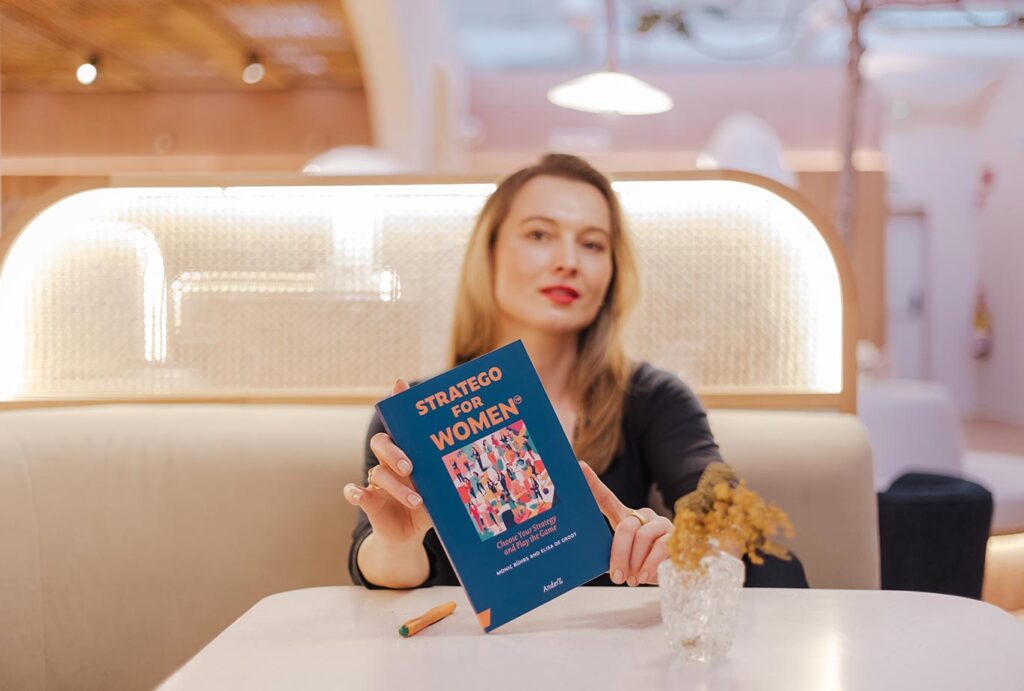
At InTouch, we believe that women do not need to become someone different in order to succeed. They simply need to know the rules that others have long since learned. That is exactly why we developed the Masterclass Stratego for Women: our flagship six-month program in which ambitious women strengthen their strategic capabilities and personal leadership.
What you will learn and experience in the Masterclass:
- Understand the unwritten rules of your organization and navigate them with confidence
- Conduct a stakeholder analysis and recognize the different types of players you are dealing with
- Profile and present yourself powerfully in a way that feels true to who you are
- Negotiate strategically for better positions, projects, and salaries
- Build a network that truly works, including access to sponsorship
- Gain practical tools you can put to use the very next day
The program takes place in small groups of no more than twelve women, creating space for depth, personal reflection, and genuine connection. With nearly 30 years of experience and more than 500,000 people reached, we bring not theory but proven strategies that work in everyday professional life.
Ready to play the game on your own terms? Get in touch and discover what the Masterclass can do for you.
Gerelateerde artikelen
- Waarom verdienen vrouwen nog steeds minder dan mannen voor hetzelfde werk?
- Hoe voorkom ik dat ik te veel een vriendin word voor mijn team in plaats van een leider?
- 10 data-driven argumenten voor leiderschapstraining vrouwen budgetten
- Wat kunnen jonge vrouwen leren van ervaren vrouwelijke CEO's?
- Wat zijn empowerment workshops voor vrouwen?